
As people go to the polls to vote in Rumson and Fair Haven on Tuesday, or even if votes have already been cast, there are some facts about the boroughs’ governing bodies and their function and history that may have eluded many.
So, the notion in mind that an informed voter is a better voter, early voting or not, here are some local government facts that may enlighten and inspire:
Rumson and Fair Haven are both run under what is dubbed the Borough form of municipal government in New Jersey. There are several forms. While it may seem like a given that since Fair Haven and Rumson are both boroughs, the form of government follows suit with that name. It’s not.
The Borough form of government is partisan, meaning that borough council members are affiliated with their particular party and elected on that partisan ticket. This form of municipal government is also a “strong” council, “weak” mayor form of government. This means that the mayor does not vote, except in the case of breaking a tie among council members.
The mayor also has veto power over ordinances (which are, essentially, borough laws). His vetoes, however, are subject to what is termed an “override” by a council two-thirds majority vote. The mayor also chairs, or runs, the meetings. The mayor, too, has the power to make professional appointments and liaison assignments to council members with the advice and consent of council.
Each council member serves as a liaison to a particular department or organization within the borough to affect better communication between departments/organizations and the governing body.
The mayor can veto ordinances subject to an override by a two-thirds majority vote of the council. The mayor makes committee and liaison assignments for council members, and most appointments are made by the mayor with the advice and consent of the council.
Borough council members are elected to serve three-year terms on a six-member council dais in a completely volunteer capacity. They are not paid a cent to serve. The mayor serves in four-year terms and is elected separately as terms expire.
What happens when a borough council member must resign/retire?
If a borough council member must resign or retire due to emergent circumstances or a move and cannot complete their term on the dais, the governing body must fill the position within 30 days. The replacement, who is chosen from a pool of candidates nominated by the borough party organization (Democrat or Republican, depending on the party affiliation of the council member leaving), serves out the remainder of the term.
Note that the resigning elected official must be replaced with someone of the same party affiliation.
The person who was appointed must run in the November election to either complete that term as an officially elected official; or, depending on the seats up for grabs, can opt to run for a full term and run a newer candidate for the shorter, unexpired term.
In Fair Haven in 2025 …
With Republican council members Kristen Hoey and Drew LaBarbera’s seats up for grabs, four are vying for the two spots on the governing body dais — two Republicans and two Democrats. Hoey and LaBarbera are finishing up their first and only three-year terms on council and have opted not to run for a second term.
Fair Haven has long had a Republican-dominated borough council, with Democrats in more recent years winning seats. Currently, there is one Democrat on the Republican-dominated council.
This election’s candidates are all newcomers to the race: Democrats Christina Malecki and Harold Baker; and, Republicans Joe Duva and Kevin Griffin.
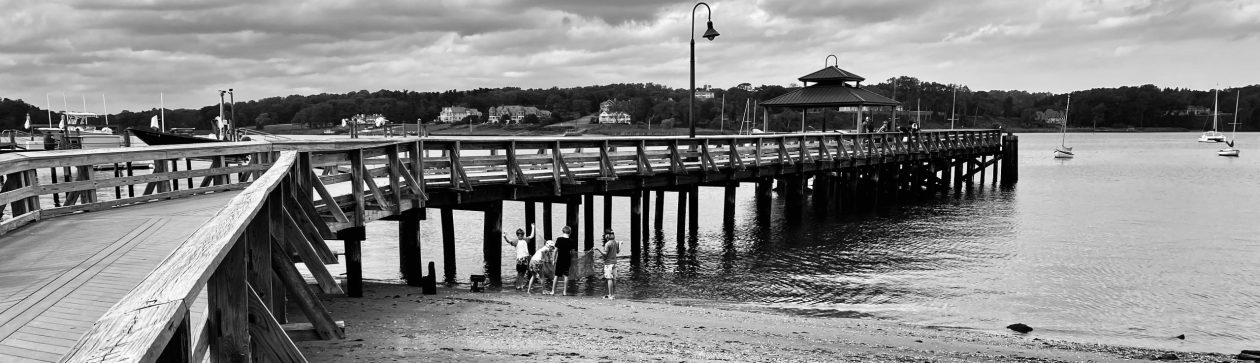
The major issues in Fair Haven are: affordable housing, business and residential zoning and revisiting the Master Plan, brush collection, garbage and recycling, the upcoming riverfront park next to the borough dock at 21 Fair Haven Road and maintaining quality of life at the riverfront and dock without infringing on the public’s passive recreation and fishing and crabbing rights on the waterfront, which carries with it guaranteed public access.
About Fair Haven
Fair Haven is a roughly 1.6-square mile borough with about 6,000 residents, most of them families and homeowners. The last U.S. Census report indicated that more than 70 percent of the residents of Fair Haven are married couples. There are roughly 1,700 families.
About the Fair Haven Borough Council Candidates …
Democrats Christina Malecki and Harold Baker

Malecki and Baker are newcomers to the council race.
Both are longtime Fair Haven residents, though Malecki was raised in Fair Haven and graduated from its schools and Rumson-Fair Haven Regional High School (RFH) in 2006.
The team boasts a platform of proven experience, commitment to preserving Fair Haven’s traditions, open space preservation and “building a safer, transparent future.“
Malecki has a career in the tech industry, with a concentration in digital sales, technology resourcing, and business strategy.
Baker has been a Fair Haven resident since 2007. A graduate of Rutgers University and Brooklyn Law School, he is an attorney focused on criminal defense, civil rights, and personal injury litigation.
More about Malecki and Baker from the candidates’ website …
Currently a board member of the Fair Haven Historic Association, Malecki is committed to preserving the town’s historic charm while supporting responsible, thoughtful improvements. Her priorities include public safety, safer streets, well-maintained open spaces, strong schools, and a transparent, responsive local government.
Known for his even-handed approach and ability to build consensus, Baker is a familiar face in the community, having coached multiple local youth sports teams.
“I love Fair Haven’s small-town feel, its walkability, and its schools,” said Baker. “From the Baseball Parade and Fair Haven Day to crabbing off the dock and the Fireman’s Fair, I care deeply about the people and traditions that make this town special. I’m committed to improving services and programming for residents of all ages.”
As parents, professionals, and civic volunteers, they are eager to give back and help shape the future of the town they call home.
Republicans Joe Duva and Kevin Griffin

The Duva-Griffin team, both newcomers to the race, boasts a platform of experience, insight and community involvement. Specifically, the two are “committed to upholding the town’s legacy of safety, preservation, efficiency, transparency, and fiscal responsibility,” campaign literature says.
Griffin, a senior executive at a national sales organization for a “top global communications company” (unnamed), has lived with his wife and children on Spruce Drive since 2011.
Originally from Connecticut, Duva, a Cornell University graduate, lived in “a nearby beach community” (unnamed) before moving to Grange Avenue. He is an active volunteer firefighter in Fair Haven. In his professional career, Duva serves as head of corporate strategy for a global Real Estate Investment Trust. His career background includes leadership roles at Citibank, Mercer, IBM, and Instacart.
More about Duva and Griffin from the candidates’ website …
Duva, in his career, has expertise in strategy, innovation, product development, and operations.
When he is not working or volunteering at the firehouse, he is busy restoring his family’s 75-year-old home and taking his young daughter for walks through Fair Haven’s parks and trails. Through his year-round firefighting service and related volunteerism at the annual Fireman’s Fair, Duva said in the release on the team’s website that he “has met a great number of residents and has gained a deep understanding of the community’s values.”
Griffin is well-versed in his career in overseeing a high-revenue operation with full profit-and-loss responsibility. Known for his collaborative, results-driven leadership, Kevin has built a career on delivering success.
A dedicated volunteer and avid golfer, Kevin has been actively involved in youth sports, launching the very successful travel softball league and coaching every sport imaginable. Kevin also supports organizations such as the American Heart Association, First Choice Women’s Resource Center and the American Cancer Society.
About the Uncontested Rumson Borough Council Race …
In Rumson, two Republican Borough Council members’ seats are up for grabs with no challengers, which is common in the long Republican-dominated, or fully-Republican council.
The current terms of James Kingsbury and Michael Lospinuso end this year. The two are on the ticket with no Democrats challenging them. Unless a write-in candidate, or two, happens to get a majority of votes, the two incumbents will serve additional terms on the dais.
Editor’s note: You may have noticed that R-FH Retro’s candidates’ Q&As are absent this election. At R-FH Retro we, in true professional journalistic form, strive to ensure balance in coverage. Local election coverage is a big part of that goal.
Take a moment to read and process our position …
Traditionally, the press has served as a watchdog for the public, fielding questions in candidate interviews that target issues critical to the towns candidates are vying to serve. Accessibility, transparency and accountability are at the core of an elected official’s work.
In years past, in traditional newsrooms, Q&As were not the method chosen for candidate coverage. Interviews were conducted via telephone or in person and candidates used those interviews as opportunities to answer to the public they strove to get elected to serve. They, 99 percent of the time, responded to requests for interviews — and usually immediately and according to the journalist’s (very busy) schedule, not theirs. It was their opportunity to let the public get to know them via a skilled, unbiased professional.
With the advent of social media, candidates’ accessibility to journalists’ election interviews waned. Unfortunately, many, not all, candidates started to feel as if they didn’t need or want to respond to interview requests, as social media had become their public relations venue and they didn’t need the newspaper interviews upon which they used to respect and rely on heavily.
The problem with that is that there is a big difference between public relations and election coverage and news. True journalistic news coverage of elections has an invaluable benefit to the voters. The social media opportunity for candidates is great, but it is just that — social media and public relations, not balanced news coverage. In public relations, there’s no accountability, it’s just about promoting what you want to promote only rather than analysis and vetting of pertinent facts and issues via specific answers to pertinent-thought-out questions.
Traditionally, and rightly so, when there’s no response for a requested interview, the rule is three attempts and then a “refused to respond” is recorded.
In an effort to make things easier for candidates, journalists started creating election questionnaires tailored to the issues of each town and facts about the candidates’ backgrounds. We worked diligently to create the most interesting, effective questions, seeking thoughtful, specific answers to the public politicians serve.
Through the questionnaires, candidates were afforded an opportunity to answer within a period of a few days to a week. Going back several years, candidates were generally pleased with the opportunity and thankful for the chance answer the questions over the course of a few days rather than answer on the spot in an in-person interview — one chance.
Unfortunately, in more recent years, some candidates started balk over not having weeks or even as much as a month to answer and some even blatantly stated that they had no time and were “too busy” campaigning and “running the town.” Others didn’t even respond. All of that was very disheartening and much of our time was also wasted on carefully-crafted, thoughtful, insightful professional candidates’ questionnaires that, when answered with as much thought and care, benefitted the voting public that those candidates strove to have the opportunity to serve.
So, in light of the disinterest and disregard that created an inadvertent imbalance in coverage, the decision this election was made to not offer the questionnaires, as they were not taken as seriously as they should have been — or flat-out dismissed.
We would like to thank the past candidates who, in the past, were diligent, respectful and thoughtful about answering our Q&As. Thank you! The voting public thanks you! And to those who have supported R-FH Retro and its endeavors on the whole, and advertised we extend our sincere thanks. We always offered to both sides and until recent years, both sides always advertised. But, while advertising is completely separate from the election coverage, it offered a true public relations opportunity in addition to interviews that supported for hyperlocal journalism as well. Thanks to those who have advertised!
Accessibility is key to the role of a true public servant. Remember that. Thank you and best of luck to all the candidates! The work is volunteer, so to all those who serve and are running, your dedication, regardless of side or issues, and efforts are to be applauded.
— Elaine Van Develde/publisher, founding editor of R-FH Retro
- Old News: Fair Haven Firemen’s Fair and its Flying Geraldos, 10-Cent Charleston Dances, Ponies, Carousels & Spin Art
- Retro Wheel of Fair Fortune
- In Memoriam: Former Longtime Monmouth County Prosecutor John Kaye, 82
- Police Report: DUIs, Bail Jumping, Warrant
- Prosecutor: Area Man Gets 40 Years for 2023 Attempted Sexual Assault, Robbery


You must be logged in to post a comment.